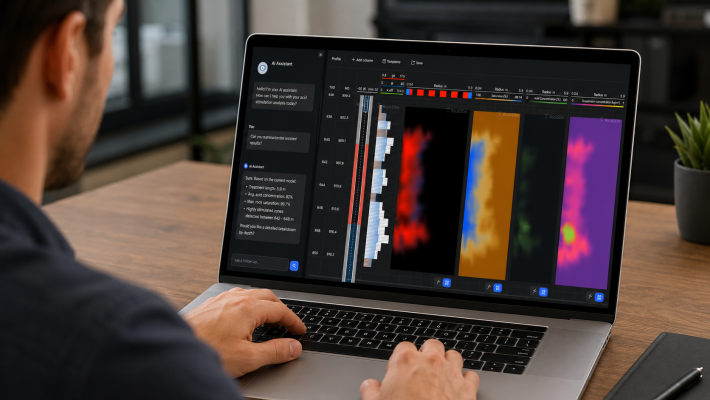
WellStim is an engineering simulator for designing and analyzing acid treatments in wells. It combines the description of the well and reservoir, fluids, and injection schedule into a single computational model, making it possible to evaluate how a selected design affects treatment distribution and the expected operational effect.
We invested significant effort in implementing complex hydrodynamics and geochemistry, and we also worked separately on the stability and speed of the computational engine so that the model could be used not only for a single design check, but also for fast iterative evaluation of different design options.
However, engineering simulators often have one common problem: they can calculate complex physics, but they require too much manual data preparation, validation of input-parameter consistency, and design iteration. This, in turn, demands a high level of expertise from the design engineer.
As CTO, I understand the architecture of WellStim from within: I was directly involved in the development of the computational core and have a strong understanding of the input data structure, the logic of pre- and post-processing, and the mechanisms for importing data into and exporting data from the core. Based on this, I formed a hypothesis: what if we gave a neural network the ability to manage the input data and run WellStim simulations on its own? And could a full-fledged system around this scenario be implemented independently in a vibe-coding mode using tools such as Codex or Claude?
WellStim already has an automated data-loading system from files in various formats: Excel, TXT, LAS, and others. But building a high-quality digital model from these files still takes time and requires serious engineering expertise. Now imagine this: you simply “drop” a folder with source data for a well into an agent, following an acid-treatment modeling checklist, and the agent assembles the computational model itself, checks parameter consistency, and prepares the design for simulation.
Or consider another scenario: you assign the agent a long-running task — “Vary the volumes, concentrations, and injection rates of reagents from this list; change the staging, diversion method, equipment, and constraints; and in one hour bring me the best design and explain why it is the best.” In essence, this turns the simulator from a tool for manually selecting a design option into an environment for fully automated search for an engineering solution.
The next step is to connect accumulated expert knowledge: standard practices, constraints, lessons learned, and recommendations on reagents and treatment designs. In that case, together with the optimal treatment option, the engineer receives not just a set of numbers, but a report with targeted recommendations: what worked, where the risks are, which constraints influenced the result, and which options should be tested next.
To test these hypotheses, I started an experiment with Codex. The first MVP objective is to keep WellStim’s strict computational backend in place, while using AI as an interface, data orchestrator, and assistant for managing the simulation workflow.
In the following posts, I will gradually share how this experiment develops as it is implemented.